TNGECL Profile
During the first phase of power sector reforms in Tamil Nadu, Government of Tamil Nadu had accorded in principle approval in G.O.Ms.No.114 Energy (B2) Department dated 08.10.2008 for the re-organisation of TNEB by the establishment of a holding company, by the name TNEB Ltd and two subsidiary companies, namely Tamil Nadu Transmission Corporation Limited (TANTRANSCO) and Tamil Nadu Generation and Distribution Corporation Limited (TANGEDCO) with the stipulation that the aforementioned companies shall be fully owned by Government. Accordingly TNEB has been reorganized from 01.11.2010 based on the Tamil Nadu Electricity Board (Reorganization and Reforms) Transfer Scheme 2010 notified by Government of Tamil Nadu vide G.O.(Ms).No.100 Energy (B2) Department dated 19.10.2010.
Subsequently, to complete the restructuring process in Tamil Nadu, Energy Department, Government of Tamil Nadu vide G.O (Ms.) No. 7 dated 24.01.2024 has accorded approval for formation of Green Energy Company in the name of Tamil Nadu Green Energy Corporation Limited (TNGECL) to take over the Green Energy Business (Hydro, Wind, Solar etc.,) of TANGEDCO and to merge the Tamil Nadu Energy Development Agency (TEDA) and its functions with Tamil Nadu Green Energy Corporation Limited (TNGECL). Based on the above notification, TNGECL has been formed. More...DATA CARD (2022-2023)
Hydro Generation
Electricity generation in Tamil Nadu until about 1908 was confined to a few tiny plants in Tea Estates run on water power and to a small hydro electric station at Kattery near Coonoor. The Government Electricity department was created in 1927. The Pykara Hydro electric Power Station was constructed by Sir John G. Henry Howard , a British Engineer and the first Chief Electrical Engineer of the then Composite Madras State Electricity Department and commissioned in 1933 with an original installed capacity of 70 MW.
PYKARA (SINGARA) HERITAGE POWER HOUSE
The Pykara Hydro Electric Scheme is the First Power Project under taken by the Government of Madras in 1929 with the help and guidance of Power Corporation London. The scheme utilizes 5 TMC water / year of the Pykara river which drains a portion of Nilgiris plateau, having a catchment of a 154.23 square Kilometers and an average rain fall of over 2000 mm / annum. The Pykara Power House is located at Singara which is above 36 Kms from Ooty at an elevation of 3400 feet above MSL. The Power House utilizes a head of 3030 feet to develop a maximum power of 70.2 MW with 7 units [During 2004, Unit 4, 11 MW capacity machine damaged and removed].
KADAMPARAI PUMPED STORAGE POWER HOUSE (4x100mw)
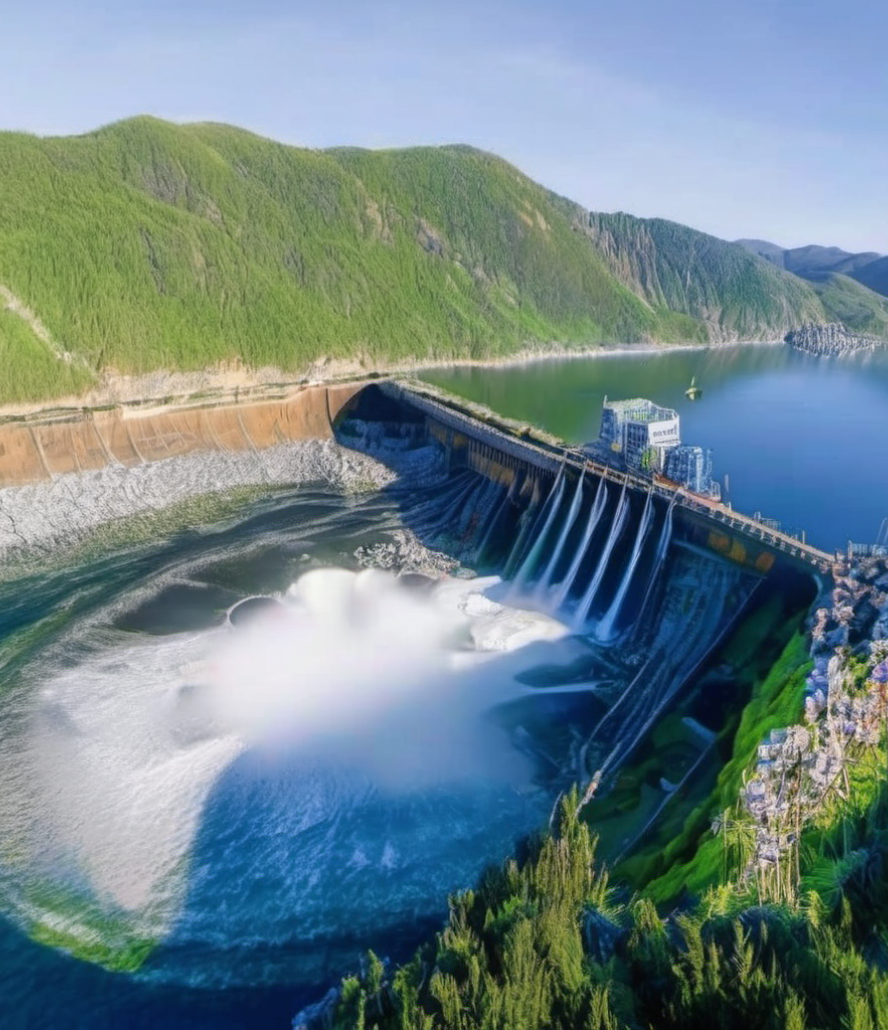
This Power House is located in the Anamalai Hills of the Pollachi Taluk in the Coimbatore District with Kadamparai dam as the upper reservoir and Upper Aliyar Dam as the lower reservoir. This is the first underground pumped Storage Scheme in erstwhile Tamil Nadu Electricity Board and the biggest Hydro capacity. This Power House is designed as Pumped Storage Hydel Station for adding valuable peaking capacity to the Tamil Nadu grid. In the Kadamparai Power House, there are four Units of 100 MW capacity each. All the four units of Kadamparai Power Houses were commissioned during 1987 – 1989. During peak hour, the required water for power generation is taken from Kadamparai Dam and delivered to Upper Aliyar Dam. During non peak hour, the water in Upper Aliyar Dam is pumped to Kadamparai dam by pumping operation achieved through reversible pump turbines
Solar Generation
Tamil Nadu has made significant strides in harnessing solar energy, and the State plays a crucial role in India's renewable energy sector. Solar energy complements the state's impressive wind energy capacity, helping to meet the growing demand for clean renewable energy. The state has made substantial investments in developing solar energy infrastructure, promoting both large-scale and rooftop solar installations. This has made Tamil Nadu as one of the leading states in solar power generation in India.TamilNadu's focus on solar energy is aligned with India's national renewable energy targets, aiming to reduce reliance on fossil fuels and transition to sustainable sources of energy. Overall, TamilNadu's robust solar energy initiatives continue to position the state as a major player in India’s green energy transition.More...


Wind Generation
Tamil Nadu stands in the second position in India in terms of installed wind energy capacity, showcasing its commitment to renewable energy development.More...
Key wind-passing areas that enable high wind power generation include: Aralvoimozhi Pass (Kanyakumari, Tirunelveli) Kambam Pass (Theni, Dindigul) Palghat Pass (Coimbatore) Sengottah Pass (Tenkasi)